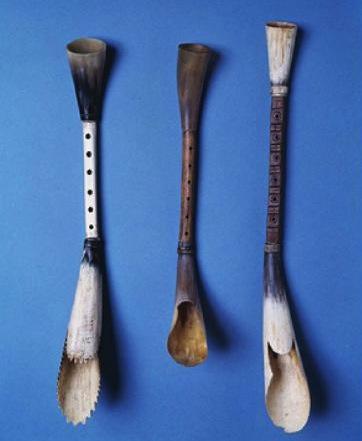
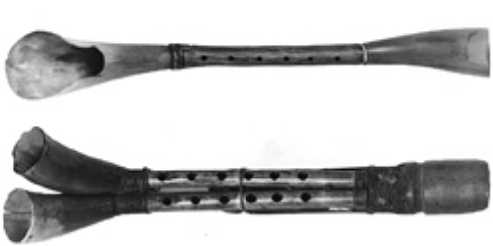
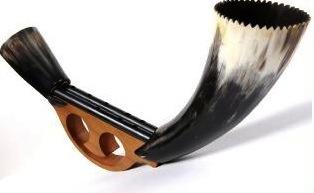
The Welsh Pibgorn or "horn-pipe" (also pib cyrn, pibgyrn or pib y bugail ) is one of the oldest Welsh instruments known. The laws of Hywel Dda (codified 94050) specify that every master employing a pencerdd (chief musician) should give him the necessary harp, crwth and pibgorn. However the instrument was not described in writing until about 1775. There is some iconographic evidence in church windows and carvings from the 14th and 15th centuries. There are 3 specimens from the 18th century in the Museum of Welsh Life at St. Fagans in Cardiff.


(18th C. pibgorns from Mon cited in Grove)
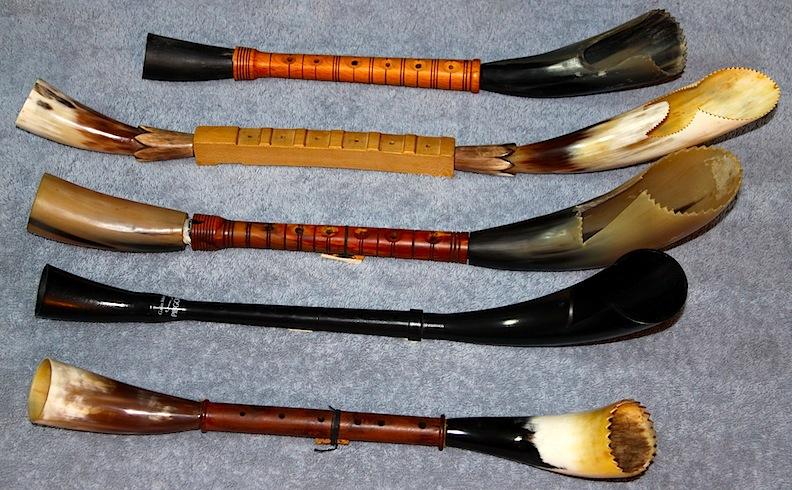
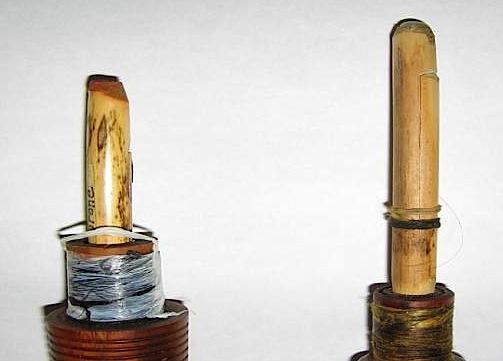
The Pibgorn is essentially a wooden pipe made from Elder with 6 finger holes and one thumb hole. There is a horn bell at one end to project the sound, and a horn wind-cap at the other to collect and funnel the wind through a reed. The reed used is a split cane reed (single reed) like that found in the drone of a bagpipe.
Reed Pipes with a single beating reed are classified as Clarinets by Curt Sachs in his work "The History of Musical Instruments" and are traced to Central Asia where the Chinese borrowed them from the "Tatars". It was they who first covered the two ends of the pipe with caps of ox horn. The instrument with two horns is rare and seems to have spread along the sea routes leading from "the Indian Ocean through the Mediterranean into the Atlantic." It is found in Ceylon and the Greek Archipelago, and in Europe only among the Basques and the Welsh.

Basque Alboka
Baines in his "Woodwind Instruments and their History", speculates that the horn on the bottom end of the pipe was most likely a copy from its use on primitive cane and wooden trumpets and cites a number of "hornpipes" all over the world with horn only on the bottom end. The Moroccan Mizmar for example uses two horns on the bottom but a double reed on top and no wind cap.
Marcuse in her "A Survey of Musical Instruments" agrees with both and further points out that the Welsh pipe could be made from bone or wood, and was still being played by shepherds on Anglesey (Mon) as late as 1870. Its Scottish counterpart , played in southern Scotland is now extinct and was rare in 1794 when Robert Burns tried to obtain an example. Only 2 specimens of the Scottish variety have been preserved. Burns wrote:
"I have at last gotten one. It is composed of 3 parts, the stock, which is the hinder thigh-bone of a sheep..the horn, which is a common highland cows horn..and lastly the oaten reed exactly cut and notched like that which you see every shepherd boy have when the corn-stems are green and full grown. The stock has 6 or 7 ventiges on the upper side and one back ventage...."
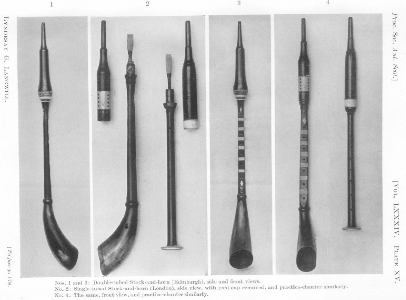
For an interesting article on the Scottish version of the pibgorn check out: "THE STOCK-AND-HORN" by Lyndesay G. Langwill, available as a pdf file on line.

Examples of Stock and Horn from Langwill's article. Instrument clearly has a double reed instead of the pibgorn's single reed.
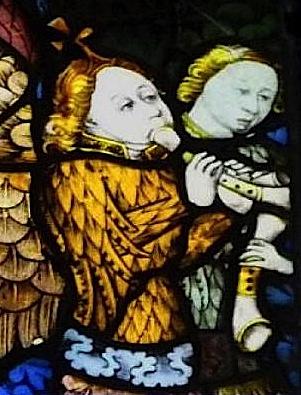
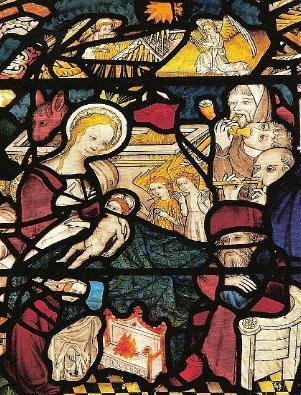
In England and Wales there is iconographic evidence from the 15th and 14th centuries. An illuminated initial in the Beauchamp Psalter (1372) contains the figure of a shepherd playing what seems to be a single hornpipe with mouth horn. In the Beauchamp window (1447) of St Mary's Church, Warwick, two angels are holding single hornpipes. They resemble surviving pibgorns, except that they have five rather than six finger-holes, with the horn bell at the end having a straight cut rather then a serrated one.
Music scholars have found that in some Russian and Albanian hornpipes the reeds are taken directly in the mouth, as they were in older Scottish forms of the instrument.
Pibgorns are loud and were most likely played outdoors for dancing or for the enjoyment of shepherds.
Today's pibgorns usually play one octave from d to d. But with a good reed and cross fingering I can reach an high E easily and sometimes, if the pibgorn gods are smiling, an F#.
Moch Pryderi uses pibgorns by John Tose and Jonathan Shorland of Wales, and Alan Keith of California.
The Moch's new Pibgorn by JONATHAN SHORLAND

The Moch's Pibgorns by JOHN TOSE and ALAN KIETHNS


Modern Pibgorns by John Tose and Alan Keith

Pibgorn reeds without the wind cap.

Single pibgorn reed.
For really great info on pibgorns, pibgorn making and reed making check out "A Pratical guide to making pibgyrn" by Gerard KilBride
For a lot of really great Welsh tunes for Pibgorn and Welsh Pipes see John Tose's Collection
here 
For Steve Jeans youTube demos on Pibgorn reed making
and 
SOME MORE PIBGORN CLOSE RELATIVES !

11th C. Falster Horn Pipe (?) Denmark


Russian Zhaleika

Ukrainian Rizhok

Finnish Lavikko

Spanish Gaita Gastoreña
The songs you hear are "Llongau Caernarfon" "Ffarwel i Aberystwyth" "Morfa Rhuddlan" and "Mopsi Don" played on the Pibgorn made by John Tose.

Bill playing a Pibgorn by John Tose.


Sometimes two are better !! Bill & Mary.
(Photo by Roddy Johnson)
For more reading on Pibgorns:
BIBLIOGRAPHY
D. Barrington: ‘Some Account of Two Musical Instruments used in Wales’, Archaeologia, iii (1775), 3034
H. Balfour: ‘The Old British ‘Pibcorn’ or ‘Hornpipe’ and its Affinities’, Journal of the Anthropological Institute, xx (1890), 14254
F.W. Galpin: Old English Instruments of Music (London, 1910/R, rev. 4/1965/R by T. Dart)
F. Crane: Extant Medieval Musical Instruments (Iowa City, 1972), 46
M.S. Defus: ‘The Pibgorn’, Welsh Music, iv/1 (19725), 510
J. Shoreland: ‘The Pibgorn’, Taplas, no.17 (1986), 15
T. Schuurmans and D.R. Saer: ‘The Bagpipe’, Taplas, 21 (1987), 1215
Grove Encyclopedia of Music: "Pibgorn".
updated10/16/11